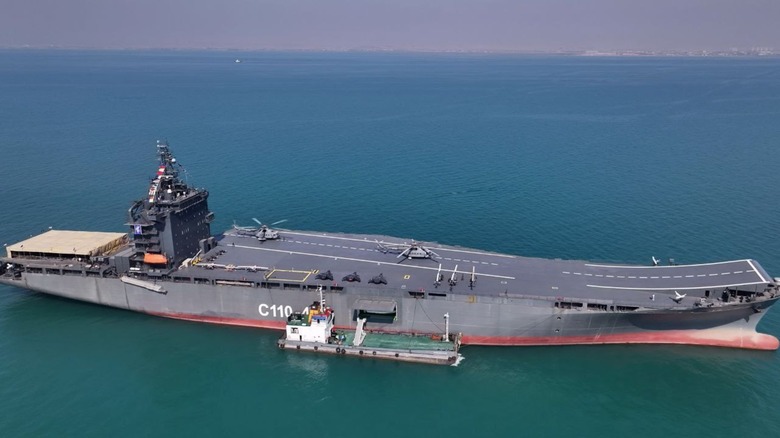
Quick Facts
- Launch Date: February 6, 2025
- Vessel Type: Converted commercial container ship (ex-Perarin)
- Total Displacement: 41,978 tons
- Dimensions: 240.79 meters long by 32.2 meters wide
- Propulsion: Diesel powered (MAN B&W 8S70MC-C)
- Maximum Range: 22,000 nautical miles
- Air Wing Capacity: 60+ unmanned aerial vehicles and helicopters
- Strike Capability: 8 Noor/Qader cruise missiles and 30 fast attack boats
The commissioning of the Shahid Bagheri drone carrier marks a pivotal shift in Iran asymmetric naval capabilities. Unlike the nuclear-powered USS Gerald R. Ford, this vessel is a masterclass in cost-effective conversion. The Shahid Bagheri is a converted container ship acting as a mobile forward operating base, featuring a ski-jump flight deck and a 22,000 nautical mile range to extend Iran's maritime reach.
Engineering Feat: Shahid Bagheri Container Ship to Aircraft Carrier Conversion
The transformation of a massive logistics vessel into a combatant is rarely a straightforward task. The foundation of the Shahid Bagheri drone carrier lies in a hull originally constructed at the Hyundai Heavy Industries shipyard in South Korea, known as Yard No. 1247. Originally a 3,280 TEU container ship named Perarin, the vessel provided the Islamic Revolutionary Guard Corps Navy (IRGCN) with a ready-made platform that bypassed the decades-long design cycle required for a ground-up aircraft carrier.
Engineers undertook a significant structural overhaul to prepare the hull for its new role. A key element of this Shahid Bagheri container ship to aircraft carrier conversion was the extension of the beam. To accommodate an angled flight deck, the deck was widened by roughly 18 meters on the port side. This modification allows for simultaneous launch and recovery operations, though it lacks the complex arresting gear found on Western carriers.
Propulsion is provided by a single MAN B&W 8S70MC-C diesel engine, capable of generating 26,160 kW. While this does not offer the sprint speeds of a dedicated destroyer, it provides the steady endurance required for long-range patrols. The most striking visual feature is the 12-degree ski-jump ramp installed at the bow. This ramp is essential for launching fixed-wing drones with heavy payloads, providing the necessary lift without the need for steam or electromagnetic catapults.
Spec-to-Spec: Shahid Bagheri vs USS Ford Size and Spec Comparison
When looking at Shahid Bagheri vs USS Ford size and spec comparison, it is vital to understand that these vessels belong to different tactical universes. The USS Gerald R. Ford is a purpose-built supercarrier designed for high-intensity power projection and total air superiority. In contrast, the Shahid Bagheri is a specialized platform for unmanned systems and guerrilla-style naval warfare.
The USS Gerald R. Ford is the world's largest aircraft carrier with a displacement of over 100,000 tons and a length of 337 meters, while Iran's Shahid Bagheri drone carrier is a converted commercial container ship with a displacement of approximately 42,000 tons and a length of 240 meters. These numbers highlight a massive disparity in raw physical presence and payload capacity.
| Feature | USS Gerald R. Ford (CVN-78) | Shahid Bagheri (IRGCN) |
|---|---|---|
| Propulsion | 2x A1B Nuclear Reactors | 1x Diesel MAN B&W |
| Operational Range | Unlimited (25-year fuel life) | 22,000 nautical miles |
| Launch System | Electromagnetic Aircraft Launch System (EMALS) | 12-degree ski-jump ramp |
| Flight Deck | 1,092 feet (Catobar) | 180-meter flight deck with a ski-jump ramp |
| Primary Aircraft | F-35C, F/A-18E/F, E-2D | Shahed-136, Mohajer-6, JAS-313 |
| Defenses | RAM, Phalanx CIWS, Evolved Sea Sparrow | Noor Cruise Missiles, Kowsar-222 SAMs |
The drone carrier vs aircraft carrier differences are most apparent in the launch and recovery cycle. The USS Ford utilizes EMALS to support an air wing of more than 75 aircraft, including heavy manned fighters that can strike targets hundreds of miles away. The Shahid Bagheri, however, is designed to operate approximately 60 drones and helicopters. The Shahid Bagheri drone carrier range and endurance specs are also distinct; while the nuclear-powered USS Gerald R. Ford possesses unlimited operational range and endurance, the diesel-powered Shahid Bagheri has a reported maximum operational range of 22,000 nautical miles.
Operational Geometry: Iran Asymmetric Naval Capabilities
The strategic value of the Shahid Bagheri is not found in its ability to win a one-on-one duel with a supercarrier. Instead, it serves as a Mobile Forward Node within an asymmetric maritime strategy. Traditionally, Iran's naval power was confined to the Persian Gulf and the Strait of Hormuz. By deploying a Shahid Bagheri drone carrier, the IRGCN can now project power deep into the Arabian Sea and the Gulf of Oman, effectively moving their launch point closer to critical chokepoints like the Bab el-Mandeb.
This vessel is a force multiplier for anti-access area denial (A2/AD) tactics. It functions as a floating command center for distributed operations. Below the flight deck, the ship is designed to carry up to 30 Tareq-class fast attack boats and various unmanned surface vehicles. These small, high-speed craft can be launched for swarm attacks, overwhelming the sophisticated defenses of larger conventional warships.
By extending the reach of their sensors and strike platforms, Iran asymmetric naval capabilities now include the ability to monitor and potentially disrupt commercial shipping lanes far from their own coastline. The ship acts as a blue-water navy ambitions bridge, allowing Iran to transition from a coastal defense force to a regional expeditionary power without the prohibitive cost of building a conventional carrier strike group.
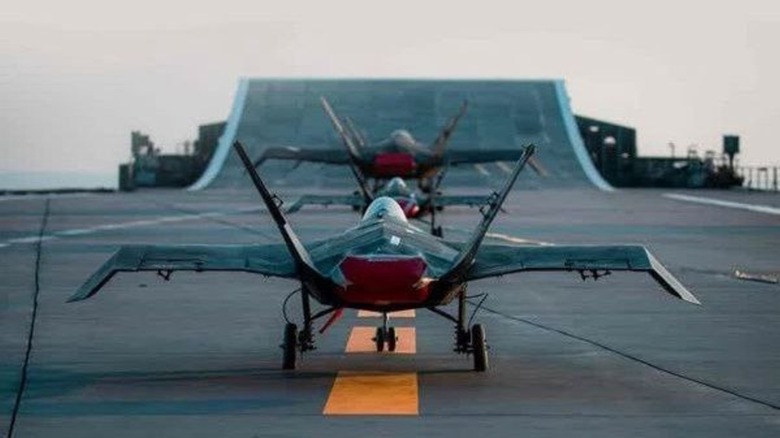
The Air Wing: Drone Types Supported by Iranian Shahid Bagheri Carrier
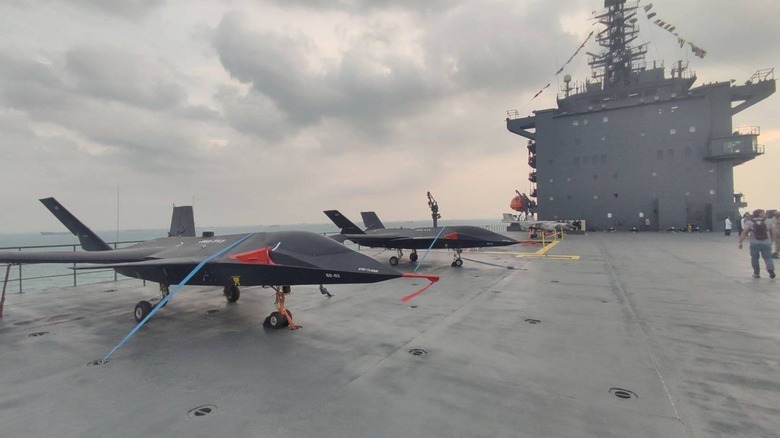
The true teeth of the vessel lie in its diverse inventory of unmanned platforms. The air wing is expected to consist of a mix of reconnaissance, electronic warfare, and loitering munitions. Central to this lineup is the Shahed series, which gained international notoriety for its long-range strike capabilities. These "kamikaze" drones can be launched in large numbers to saturate enemy air defenses.
Other drone types supported by Iranian Shahid Bagheri carrier include the Mohajer-6, which provides persistent intelligence, surveillance, and reconnaissance (ISR) capabilities. The Mohajer-6 is capable of carrying precision-guided munitions, making it a versatile tool for both spotting and engaging targets. Additionally, the JAS-313, a maritime variant of the Qaher drone, is designed specifically for operation from the ship's ski-jump deck.
To protect these assets, the Shahid Bagheri missile systems and defensive capabilities include an array of 8 Noor or Qader anti-ship cruise missiles. These missiles have ranges exceeding 200 kilometers, providing a significant standoff threat to any vessel approaching the carrier. For close-in protection, the ship is outfitted with Kowsar-222 surface-to-air missiles and multiple gatling-style point defense systems. The internal structure includes two levels of hangars, allowing for the maintenance and storage of drones and helicopters away from the corrosive salt air of the open sea.
FAQ
What is the Shahid Bagheri drone carrier?
The Shahid Bagheri is a naval vessel operated by the Islamic Revolutionary Guard Corps Navy of Iran. It is designed specifically to serve as a mobile launch platform for a wide range of unmanned aerial vehicles and helicopters, extending Iran's operational reach into international waters.
Is the Shahid Bagheri a converted container ship?
Yes, the vessel was originally a 3,280 TEU commercial container ship named Perarin. It was built by Hyundai Heavy Industries in South Korea before being acquired and heavily modified by Iranian naval engineers to include a flight deck and military systems.
What are the specifications of the Shahid Bagheri flight deck?
The flight deck is approximately 180 meters long and features an angled section to allow for simultaneous operations. It is equipped with a 12-degree ski-jump ramp at the bow to assist in the takeoff of fixed-wing drones that require high lift.
How does the Shahid Bagheri compare to a traditional aircraft carrier?
A traditional aircraft carrier like the USS Gerald R. Ford is a nuclear-powered supercarrier designed for manned fighter jets and global power projection. The Shahid Bagheri is much smaller, diesel-powered, and focused exclusively on asymmetric warfare using drones and small attack boats.
What types of UAVs are expected to operate from the Shahid Bagheri?
The carrier is designed to support various Iranian drones, including the Shahed-136 loitering munition, the Mohajer-6 for reconnaissance and light strikes, and the JAS-313, which is a specialized maritime drone.