Quick Facts
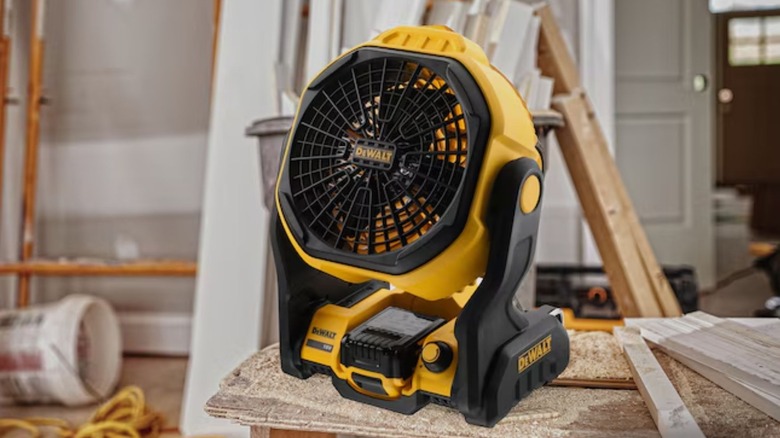
- Airflow Performance: The unit delivers 650 CFM of concentrated airflow for maximum air displacement.
- Durability Rating: Features an IP54 ingress protection rating to withstand dust and water splashes.
- Runtime Efficiency: Offers up to 4.5 hours on high speed with a 5.0Ah battery or roughly 8 hours on medium with a 4.0Ah battery.
- Odor Strategy: Best used as an exhaust by pointing the fan out of a window to pull fumes away.
- Pest Control: High-velocity air acts as a mechanical barrier against flying insects like mosquitoes.
- Maintenance: Regular cleaning of the intake obstruction is required to maintain peak CFM performance.
To effectively ventilate strong odors or VOCs, position the DeWalt jobsite fan in an open window or doorway facing outward. This setup creates an exhaust effect that pulls stagnant air and aerosol fumes out of the workspace, while the high-velocity airflow also functions as a portable pest control fan by creating a wind barrier that flying insects cannot penetrate.
The Exhaust Strategy: Odor Ventilation Hacks
When you are working in a confined space—whether you are applying a fresh coat of lacquer in a basement or stripping old paint in a bathroom—the immediate instinct is to point a fan directly at yourself. While this provides a cooling breeze, it does a poor job of actually clearing the air. To master shop fan ventilation hacks, you need to understand the principle of negative pressure. By turning your DeWalt jobsite fan around and pointing it out of a window or doorway, you transform the tool into a powerful exhaust system.
This positioning creates a vacuum-like effect that draws VOC extraction out of the room rather than just swirling chemicals around your head. The 650 CFM of concentrated airflow provided by the DCE512B model is more than enough to cycle the air in a standard-sized room several times an hour. For the best results, you should crack a second window or door on the opposite side of the room. This facilitates cross-ventilation, ensuring that fresh air is constantly being pulled in to replace the contaminated air being pushed out.

Using dewalt jobsite fan for odor ventilation is particularly effective during heavy remodeling. If you are using floor sealants or industrial adhesives, you can significantly reduce the curing and off-gassing time. Instead of waiting 24 hours for that "new floor smell" to dissipate, the high-volume air movement can clear the atmosphere in a fraction of the time. When optimizing dewalt fan runtime for long odor removal, consider your battery choice. While a 5.0Ah battery is great for 4.5 hours on its maximum speed setting, switching to a lower speed or using a 9.0Ah FlexVolt battery can keep the exhaust running through the entire drying phase.
Another often-overlooked benefit of this setup is humidity regulation. In damp basements or after a pipe leak, stagnant air zones become breeding grounds for mold. By strategically placing the fan to move air out of these damp pockets, you accelerate evaporation. This proactive approach to preventing jobsite mold with dewalt 20v fan is a standard trade secret among restoration pros who need to dry out subfloors quickly.
Mechanical Pest Control: Bugs and Camping Tips
Beyond the construction site, the DeWalt jobsite fan has gained a cult following in the camping and tailgating communities as a chemical-free insect mitigation tool. Most flying pests, particularly mosquitoes and houseflies, are relatively weak fliers. They rely on calm air to navigate toward their targets. By utilizing the portable pest control fan properties of the DeWalt system, you can create a "no-fly zone" around your picnic table or tent entrance.
The high-velocity wind shear generated by the fan makes it physically impossible for small insects to land. When considering dewalt fan placement for effective fly control, you should aim the airflow across the area you want to protect, rather than directly at it. If you are sitting at a table, place the fan at one end so the air column sweeps across the tabletop. This creates a moving wall of air that bugs simply cannot penetrate.

The portability of the 20V system is the real game-changer here. Unlike traditional oscillating fans that require an extension cord, you can take these dewalt cordless fan tips for camping bug repellent deep into the woods or out onto a dock. Because the fan utilizes brushless motor efficiency, it manages to move a massive volume of air without draining your batteries instantly. If you are planning an evening outdoors, a single 6.0Ah battery will usually last through the peak "mosquito hour" and well into the night on a medium setting.
Troubleshooting Low Airflow and Power Issues
Even the most rugged tools require a bit of maintenance to keep them performing at peak levels. If you notice your DeWalt jobsite fan isn't moving as much air as it used to, or if the motor sounds like it's straining, the culprit is almost always an intake obstruction. In woodworking shops or on jobsites with heavy drywall sanding, fine dust and sawdust accumulate on the back grill and the fan blades themselves. This buildup disrupts the aerodynamics, significantly reducing the CFM performance.
To fix this, ensure the battery is removed, then use a canister of compressed air or a shop vac to clear the debris from the rear intake. For a deeper clean, some users carefully remove the front cage to wipe down the blades. Keeping the blades smooth ensures that the fan can slice through the air with minimal resistance, which also helps in preserving the motor's longevity.

Another common issue is the "drooping head" syndrome. Over time, the pivot tension adjustment on the sides of the fan can loosen, causing the fan to tilt downward on its own. This is frustrating when you’re trying to maintain a specific angle for VOC extraction. Simply tightening the knobs on the side of the housing will restore the friction needed to keep the fan locked in place.
If you are experiencing electrical issues, such as the fan shutting off after a minute of use, check your battery's health. High-draw tools like fans can be sensitive to older batteries that have high internal resistance. Also, be aware of the model differences. The older DCE511 was a hybrid model that included an AC plug, whereas the newer DCE512 is strictly cordless. If you are looking for dewalt 20v fan troubleshooting for low airflow, always ensure you are using a high-capacity battery (5.0Ah or higher) to ensure the motor gets the consistent voltage it needs for high-speed operation.
FAQ
How long does the battery last on a DeWalt jobsite fan?
On the maximum speed setting, a 5.0Ah battery typically provides about 4.5 hours of continuous runtime. If you switch to the medium or low settings, you can extend this significantly, with a 4.0Ah battery often lasting up to 8 hours on medium. For the longest possible use, high-capacity FlexVolt batteries are recommended.
Can DeWalt jobsite fans run on AC power?
This depends on the specific model you own. The older DCE511 model is a hybrid fan that features both a 20V battery port and an AC plug-in for extension cords. However, the newer DCE512 model is a dedicated cordless tool and does not have an AC power option, relying entirely on the 20V MAX or FlexVolt battery platforms.
Are DeWalt fans waterproof or weather-resistant?
The DeWalt DCE512B carries an IP54 rating, which means it is certified to be resistant to dust ingress and splashes of water from any direction. While it can handle a light drizzle or a dusty construction site, it is not waterproof and should never be submerged or left out in heavy rainstorms.
How much air does a DeWalt jobsite fan move?
The fan is engineered to deliver 650 CFM (Cubic Feet per Minute) of airflow. This high-velocity output is designed to provide concentrated air movement that can be felt from several yards away, making it effective for both personal cooling and larger tasks like ventilating work areas.
Can you mount a DeWalt jobsite fan on a wall or tripod?
Yes, the fan is designed with multiple mounting options. It features integrated hang hooks on the bottom for 2x4 lumber or pipes, screw slots for permanent wall mounting, and a standard 5/8-inch and 1/4-inch tripod thread. This versatility allows you to position the fan high up for better cross-ventilation or pest control.
To get the most out of your 20V system, make it a habit to wipe down the intake after every heavy job. Keeping the airflow path clear is the simplest way to ensure your cordless fan utility tips translate into real-world performance. Whether you are battling summer humidity, stagnant shop air, or a cloud of mosquitoes, a well-maintained fan is your best line of defense.