Our Top Picks
The Nanoleaf Umbra collection features the Cono and Cup smart lamps, combining Nanoleaf's Matter-over-Thread technology with Umbra's minimalist design. The Cono is our choice for portability and creative placement, while the Cup is the ultimate desk companion for those needing functional organization alongside smart illumination. Both lamps offer over 16 million colors and support local control via Bluetooth or integration into smart home ecosystems using a Matter-compatible hub.
This Nanoleaf Umbra review explores how these two devices bridge the gap between smart home designer lighting and practical everyday utility. Whether you are looking for Nanoleaf Umbra Cono performance in a portable format or the stationary Nanoleaf Umbra Cup features for your workspace, this collaboration represents a significant step forward for the Matter over Thread ecosystem.
Design Philosophy: When Nanoleaf Meets Umbra
Smart home lighting has often struggled with a "gadget-first" identity, where the technology is impressive but the physical form feels like an afterthought. This collaboration changes the narrative. By partnering with the Canadian design house Umbra, Nanoleaf has moved away from the geometric wall panels that defined their early years toward a more organic, industrial design aesthetic. The Nanoleaf Umbra collection is built around modern minimalism, utilizing clean lines and a matte finish that fits seamlessly into a contemporary interior.
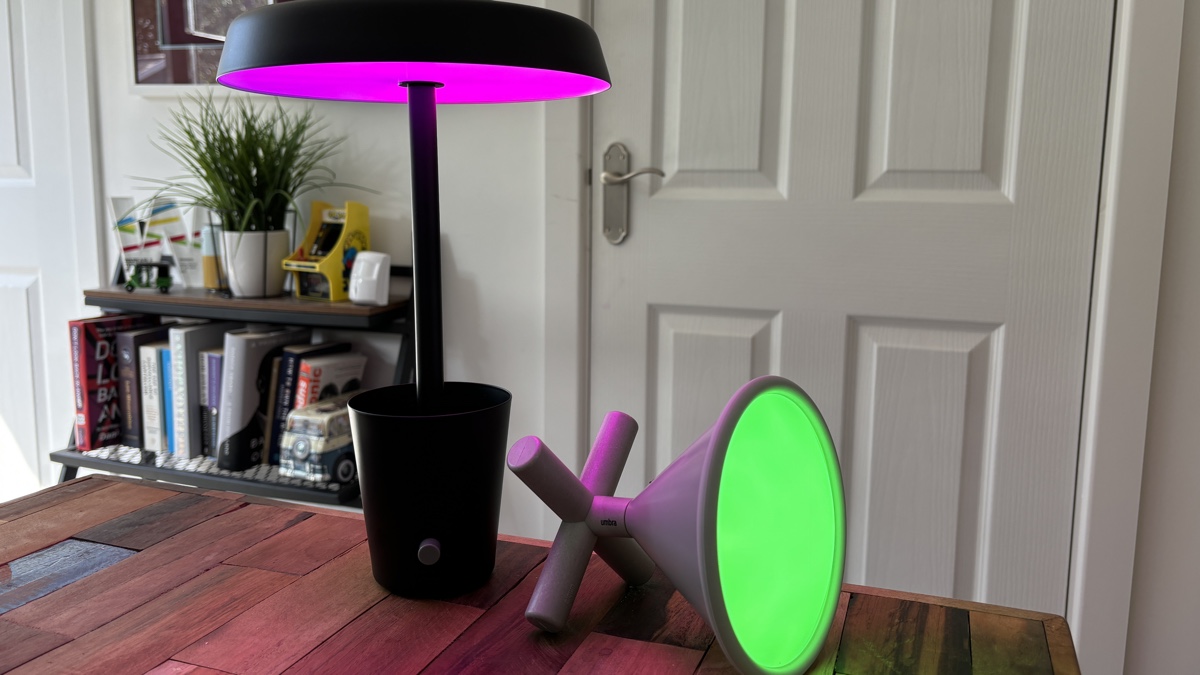
The materials used in these lamps reflect a shift toward sustainability. The outer shells are crafted from recycled plastic, yet they maintain a high-quality feel that avoids the "toy-like" texture often associated with eco-friendly plastics. The Cono features a distinct cross-shaped base that allows it to stand in multiple orientations, while the Cup integrates a utilitarian storage space into its base. This design-forward approach ensures that the lamps look like premium decor even when they are turned off.
Nanoleaf Umbra Cono: Portable Versatility Tested
The Cono is the standout for anyone seeking flexible, portable illumination. Its most striking feature is its multi-positional design. Thanks to the X-shaped legs, you can stand it upright as a standard table lamp, tilt it sideways to highlight a specific object, or even hang it upside down if the environment allows. This versatility makes it more than just a lamp; it is a tool for creative lighting.
In my real-world testing, I focused heavily on Nanoleaf Umbra Cono performance regarding mobility. The lamp is incredibly light, and the integrated handle-like legs make it easy to carry around the house. I used it as a handheld torch to navigate the hallway at night and as a soft accent light on a patio table during dinner. While the official specs state that the built-in lithium-ion battery provides up to five hours of cordless lighting, I actually managed to squeeze out nearly six hours when keeping the brightness at a steady 50%.
Regarding the Nanoleaf Umbra Cono battery life and portable performance, the USB-C charging port is conveniently located, though it is worth noting that the lamp is primarily an ambient light source. With a max output of 130 lumens, it won't light up a whole room, but its diffused glow is perfect for setting a mood. Furthermore, the Nanoleaf Umbra smart lamp color accuracy and CRI review reveals a rating of over 90, which means colors look natural and vibrant rather than washed out, even when using the full RGBW color spectrum.
Nanoleaf Umbra Cup: The Functional Desk Organizer
If the Cono is about movement, the Cup is about focus. This is a corded lamp designed to live on a desk or a bedside table. The Nanoleaf Umbra Cup features a hollow, cup-shaped base that serves as a task light storage solution for pens, rulers, or Apple Pencils. It effectively eliminates the need for a separate desk organizer, which is a huge win for those of us trying to maintain a minimalist workspace.
The brightness levels on the Cup are significantly higher than the Cono. The Nanoleaf Umbra Cup Smart Lamp delivers an average brightness of 320 lumens, making it much more suitable for reading or focused work. I conducted a Nanoleaf Umbra Cup desk organizer functionality test over a week, and the integrated USB-A charging port on the base became a central part of my workflow, keeping my smartwatch charged without needing an extra wall brick.
When deciding between the Nanoleaf Umbra Cup vs Cono which should you buy, it comes down to your primary use case. The Cup is a stationary workhorse. It lacks the battery of the Cono but makes up for it with sheer utility and higher lumen output. The light is cast through a translucent shroud that creates a soft, even spread across your desk surface, preventing the harsh shadows often created by traditional desk lamps.
Connectivity: Matter and Thread Performance
The real "smart" in these smart lamps comes from the underlying technology. Both the Cono and Cup support the Matter over Thread protocol, which is the current gold standard for smart home interoperability. If you are looking for a Nanoleaf Umbra Matter and Thread setup guide, the process is refreshingly simple.
Using the Nanoleaf app, you simply scan the Matter QR code on the base of the lamp. Because these devices use Thread rather than just standard Wi-Fi, the connection is incredibly stable and responsive. When I tested connecting Nanoleaf Umbra to Apple Home via Matter, the lamp appeared instantly in my Home app. I was able to group it with other Matter-enabled devices and create "scenes" where the lighting would shift to a warm 2700K in the evening and a crisp 6500K during my morning focus hours.
One of the major benefits of Thread is that it creates a mesh network. This means that as you add more Thread devices to your home, the connection actually becomes stronger and more reliable. Even when the Cono was at the far end of my apartment, it responded to commands from my smart speaker without the lag typical of older Bluetooth-only lamps. However, keep in mind that to enjoy the full benefits of local connectivity and remote access, you will need a Matter-compatible hub, such as a HomePod, Apple TV 4K, or a Nest Hub.
Comparing the Collection: Cono vs. Cup
To help you decide which model fits your lifestyle, here is a quick breakdown of the technical specifications and features for both lamps in the Nanoleaf Umbra series.
| Feature | Nanoleaf Umbra Cono | Nanoleaf Umbra Cup |
|---|---|---|
| Type | Portable / Rechargeable | Stationary / Corded |
| Max Brightness | 130 Lumens | 320 Lumens |
| Battery Life | 5+ Hours | N/A (Always plugged in) |
| Charging | USB-C (Input) | USB-A (Output for other devices) |
| Functionality | Multi-positional / Handheld | Desk Organizer / Pen Holder |
| Connectivity | Matter over Thread / Bluetooth | Matter over Thread / Bluetooth |
| Color Temp | 2700K - 6500K | 2700K - 6500K |
| Lifespan | 25,000 hours | 25,000 hours |
Final Verdict: Are These Designer Lamps Worth the Premium?
After spending significant time with both models, it is clear that the Nanoleaf Umbra collection is designed for a specific type of user: someone who values industrial design as much as technical performance. These are not just light bulbs in a plastic shell; they are thoughtfully designed objects that happen to have world-class smart home tech inside.
The price point is higher than a standard desk lamp, but you are paying for the Matter over Thread reliability and the unique aesthetic of the Umbra partnership. If you are already invested in the Apple Home or Google Home ecosystems, the ease of setup and the consistency of the Thread network make these a compelling purchase.
Buy the Cono if:
- You want a portable lamp that can move from the bedroom to the patio.
- You enjoy creative lighting angles and a unique, tactile design.
- You need a high-quality ambient light with excellent color accuracy.
Buy the Cup if:
- You are looking to declutter your desk while adding smart task lighting.
- You need the extra brightness (320 lumens) for reading or writing.
- You value having an extra USB charging port directly on your workspace.
Don't buy if:
- You need a primary light source to illuminate a large room.
- You do not have a Matter-compatible hub (you can still use Bluetooth, but you'll miss the best features).
FAQ
Is the Nanoleaf x Umbra lamp worth the price?
For users who value the intersection of high-end industrial design and modern smart home standards like Matter and Thread, the price is justified. You are getting a premium build quality and a future-proof connectivity standard that cheap RGB lamps cannot match.
How long does the battery last on Nanoleaf Umbra lights?
The portable Cono model features a battery that lasts approximately five hours at full brightness. In our testing at lower brightness levels, we found it could last closer to six or seven hours, making it suitable for a full evening of use. The Cup model is corded and does not have a battery.
Does the Nanoleaf Umbra Cono support Matter and Thread?
Yes, the Cono fully supports Matter over Thread. This allows for local control and seamless integration with all major smart home platforms, provided you have a compatible border router or hub.
What is the difference between the Cup and Cono Nanoleaf Umbra models?
The primary difference is portability and utility. The Cono is a battery-powered, multi-positional lamp designed for ambient light and mobility. The Cup is a stationary, corded desk lamp that doubles as a pen holder and includes a USB-A port for charging other devices.
How bright are the Nanoleaf x Umbra smart lights?
The Cono reaches a maximum of 130 lumens, making it best for accent or ambient lighting. The Cup is significantly brighter at 320 lumens, which is sufficient for task-oriented work on a desk or as a bedside reading lamp.
Is the Nanoleaf Umbra series compatible with Apple Home?
Yes, thanks to the Matter protocol, both the Cup and the Cono are fully compatible with Apple Home. Setup is handled by scanning a code, and the lamps respond quickly to Siri commands and Home app automations.