Quick Facts
- The Evolution: Cheating has transitioned from mechanical "monkey paws" to sophisticated electronic microchip reprogrammers.
- Top Innovation: The 1961 wearable computer by Edward Thorp and Claude Shannon, which used physics to predict roulette outcomes.
- Cost vs. Reward: Tommy Glenn Carmichael’s light wand cost roughly $2.50 to build but could trigger $10,000 jackpots in minutes.
- The Biggest Heist: Dennis Nikrasch used high-tech chip swapping to net approximately $16 million in winnings over several years.
- Modern Threat: Infrared contact lenses allow players to read invisible ink on card backs, making high-stakes games vulnerable.
- Casino Response: High-resolution biometric surveillance and forensic auditing are now the industry standard for catching sophisticated fraud.
Historical casino cheating devices have evolved from simple mechanical wires to sophisticated electronic gadgets. From the $2.50 light wand to high-tech wearable computers, these tools have cost casinos millions. These specialized instruments are designed to manipulate game outcomes, effectively bypassing the house edge through mechanical interference or predictive data processing.
1. The 1961 Wearable Roulette Computer: Predicting the Odds
In the world of gambling hardware, the 1961 wearable computer is the equivalent of the first Apollo moon landing. Developed by Edward Thorp and Claude Shannon, this was not a device meant to "break" the machine, but rather a tool of surgical precision designed to model the physical world.
The device was roughly the size of a pack of cigarettes and was hidden inside a pair of shoes. It functioned using toe-operated switches that allowed the user to time the speed of the roulette rotor and the ball. By inputting these two data points, the computer used predictive algorithms to calculate the decay of the ball's velocity. Once the calculation was complete, the device transmitted a musical tone to a hidden earpiece, indicating which section of the wheel the ball was likely to land in.
Thorp and Shannon were essentially performing real-time physics simulations on the casino floor. This era marked the birth of sophisticated casino fraud gadgets that relied on data rather than brute force. The beauty of the system was its subtlety; it didn't interfere with the game’s mechanics, it simply gave the player a 44% advantage over the house.
| Technical Specs | Details |
|---|---|
| Device | Thorp-Shannon Roulette Computer |
| Estimated Build Cost | $200 (1961 dollars) |
| Max Win potential | 44% House Edge Reversal |
| Years Active | 1961–1966 |
Countermeasure: The Velocity Check
Casinos eventually countered this by implementing stricter "no more bets" calls earlier in the spin, long before the ball slowed down enough for a computer to predict the landing zone with high accuracy.
2. The Light Wand and the Monkey Paw: Blinding the Slot Machine
If Edward Thorp was the scientist of cheating, Tommy Glenn Carmichael was the master of digital lock-picking. Carmichael’s career spanned decades, during which he adapted to every security upgrade the industry threw at him. His most famous invention was the light wand, a tool so simple it was terrifying to casino security teams.
The light wand was essentially a small battery-powered bulb on a wire. Carmichael discovered that he could slide this device into the payout chute of a slot machine. When positioned correctly, the light would shine directly into the machine's optical sensors. These electronic sensors were designed to count coins as they dropped to ensure the correct payout. By blinding the sensor with a concentrated beam of light, the machine’s internal logic would become "blind," failing to register that coins were being dispensed. The result was a jackpot that never stopped flowing.
Before the light wand, Carmichael used the monkey paw—a simple piece of guitar wire attached to a spring steel wand. This was inserted through the air vent to trip the microswitch manipulation mechanism. The evolution of casino slot machine cheating tools from the monkey paw to the light wand shows the transition from mechanical interference to electronic exploitation.
| Technical Specs | Details |
|---|---|
| Device | The Light Wand |
| Estimated Build Cost | $2.50 |
| Max Win potential | $10,000+ per session |
| Years Active | 1990s |
Countermeasure: Optical Shrouding
Modern slot machines now use encrypted electronic sensors and protective software that can detect if a sensor is being "overloaded" by an external light source. If the sensor sees too much light, the machine immediately triggers a tilt alarm and shuts down the payout hopper.
3. Infrared Contact Lenses: Seeing the Invisible
Card marking is as old as the deck itself, but the use of infrared contact lenses brought this ancient cheat into the 21st century. This method involves marking the backs of cards with invisible ink that is only visible under specific frequencies of the light spectrum—specifically, the infrared range.
For a player wearing these specialized lenses, the deck becomes an open book. They can see the value of every card before it is dealt, providing an insurmountable advantage in games like poker or blackjack. In 2011, an Italian gambler named Stefano Ampollini was caught using $2,000 lenses at a casino in Cannes. His success was legendary until surveillance teams noticed something odd: he was folding incredibly strong hands when his opponents had slightly better ones, almost as if he could see through the cards.
This type of cheating represents a significant challenge for identifying infrared contact lenses used in card games because the lenses themselves look like standard cosmetic contacts. Only through close-up biometric surveillance can security teams detect the slight tint or the unusual reflective properties of the lens material.
| Technical Specs | Details |
|---|---|
| Device | IR Contact Lenses & Invisible Ink |
| Estimated Build Cost | $2,000 - $5,000 |
| Max Win potential | Unlimited (High-Limit Tables) |
| Years Active | 2000s–Present |
Countermeasure: Automated Card Shufflers
To stop card marking, casinos now use automated shufflers that scan the cards for any foreign substances or markings. Additionally, high-limit rooms often use cameras with infrared filters to see exactly what the "cheater" sees, allowing them to spot the ink before the player even sits down.
4. The EPROM Re-programmer: Dennis Nikrasch’s Digital Heist
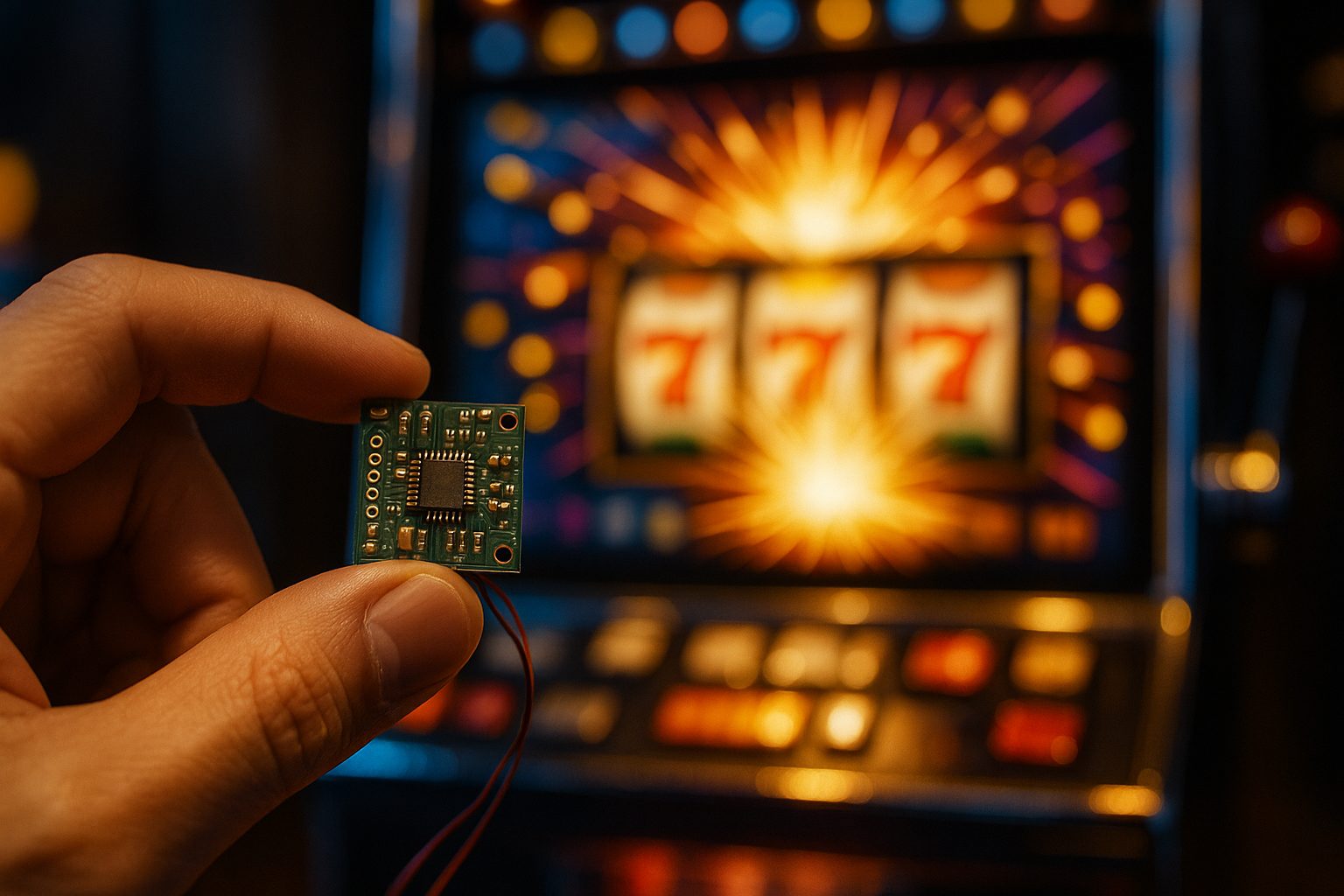
Dennis Nikrasch didn't want to trick the machine; he wanted to own it. As a former locksmith, Nikrasch understood the physical vulnerabilities of casino hardware, but he soon moved into the realm of jackpot rigging by targeting the machine’s brain: the EPROM (Erasable Programmable Read-Only Memory) chip.
Nikrasch would obtain a legitimate slot machine microchip, take it home, and use a handheld electronic device to reprogram the chip’s logic. He would alter the code so that a specific sequence of play—such as a series of small bets followed by a large one—would trigger the jackpot. He and his crew would then enter a casino, and while "blockers" shielded him from the view of the casino surveillance technology history, Nikrasch would quickly open the machine and swap the legitimate chip for his "rigged" one.
This was a high-stakes operation that required incredible speed and technical knowledge of history of slot machine cheating. Nikrasch’s downfall eventually came from an internal betrayal, but not before he had revolutionized how casinos viewed their own internal hardware security.
| Technical Specs | Details |
|---|---|
| Device | EPROM Re-programmer |
| Estimated Build Cost | $500 + Stolen Chips |
| Max Win potential | $16 Million (Total Career) |
| Years Active | 1970s–1990s |
Countermeasure: Tamper-Evident Seals
Today, the microchips inside slot machines are protected by tamper-evident seals and are housed in locked, alarmed "logic boxes." If the box is opened without a digital key, the machine is instantly bricked and security is alerted.
5. The Hidden Laser Scanner: The Ritz Casino Incident
In 2004, the gambling world was rocked when a team of three individuals won £1.3 million at London’s Ritz Casino in just two nights. Their tool of choice? A laser scanner hidden inside a mobile phone.
This was a modern evolution of the Thorp-Shannon concept. The laser would measure the "decay" of the roulette ball—the speed at which it was slowing down—and the speed of the wheel itself. This data was beamed to a remote computer that would predict the "orbit" of the ball and send the predicted landing sector back to the phone.
This case highlighted the legal ambiguity of such devices. Because the trio wasn't physically interfering with the wheel, but rather using advanced physics to predict its outcome, a judge initially ruled they hadn't technically broken the law. This incident forced a massive re-evaluation of how casinos handle mobile devices near the tables. This story remains one of the most famous examples of how casino cheating devices can be disguised as everyday tech.
| Technical Specs | Details |
|---|---|
| Device | Mobile Laser Scanner |
| Estimated Build Cost | Custom Software + Smartphone |
| Max Win potential | £1.3 Million (The Ritz Case) |
| Years Active | 2004 (High-profile incident) |
Countermeasure: Electronics Bans
You will now notice that most major casinos have a strict "no phones on the table" policy. This isn't just for etiquette; it’s a direct response to the threat of laser-based prediction.
Casino Surveillance Evolution: How the House Fights Back
The "Eye in the Sky" has come a long way since the days of guys with binoculars behind two-way mirrors. Modern casino surveillance technology history is a testament to the arms race between the house and the cheater. Today’s security floors look more like NASA command centers than security offices.
Casinos now utilize high-definition cameras coupled with facial recognition software. These systems can cross-reference every face that enters the building against the "Black Book"—a database of known cheaters and advantage players. Beyond just watching faces, AI-driven behavioral analytics monitor betting patterns. If a player’s betting spread is too perfectly aligned with the deck’s count, the system flags them for forensic auditing.
Modern slot machines also feature protective software designed to detect and block interference from external light sources or unauthorized microchip replacements. The house edge is no longer just a mathematical concept; it is a fortress protected by layers of digital and physical security. Even the mechanics of blackjack card holdout devices, which were once hidden in sleeves to swap cards, are now easily detected by thermal imaging and high-frame-rate cameras that catch "the move" in slow motion.
FAQ
What are common examples of casino cheating devices?
Historically, common devices included the monkey paw and light wand for slot machines, and wearable computers or laser scanners for roulette. In card games, infrared contact lenses and mechanical holdout devices hidden in sleeves were frequently used to gain an unfair advantage.
Do electronic cheating devices work on modern slot machines?
Most older electronic cheating devices are ineffective against modern machines. Current slots use sophisticated electronic sensors, encrypted software, and logic boxes with tamper-evident seals. Any attempt to interfere with the sensor or the EPROM chip usually triggers an immediate system lockdown.
How do casinos detect hidden cameras or cheating technology?
Casinos use a combination of high-definition surveillance, infrared cameras, and RF (radio frequency) detectors to find hidden electronics. Security teams also use behavioral analytics to spot suspicious patterns, such as a player constantly looking at their phone or making unusual betting moves that suggest they have outside information.
Are there devices that can predict roulette outcomes?
Yes, devices like the Thorp-Shannon computer and modern laser scanners can predict roulette outcomes by measuring the velocity of the ball and the rotor. While these devices are technically effective at predicting the landing sector, using them is illegal in most jurisdictions and will lead to an immediate ban and potential criminal charges.
How do infrared contact lenses work for cheating at cards?
Infrared contact lenses allow a player to see markings on the back of cards that are applied with invisible ink. These marks are invisible to the naked eye but appear as dark symbols when viewed through a lens with an infrared filter, allowing the cheater to know the value of every card in the deck.